United Kingdom Diploma
Order AQA GCSE certificate Online
- Product ID:United Kingdom Diploma
- QQ:799520747
- WhatsApp: +86 13690285467
- WeChat: 236461877
- Email: diplomacenter@qq.com
- Time: 2026-09-24 15:12
- FEEDBACK
Where can I purchase an AQA GCSE certificate?Sample AQA GCSE certificate,How much does it cost to purchase an AQA GCSE certificate?
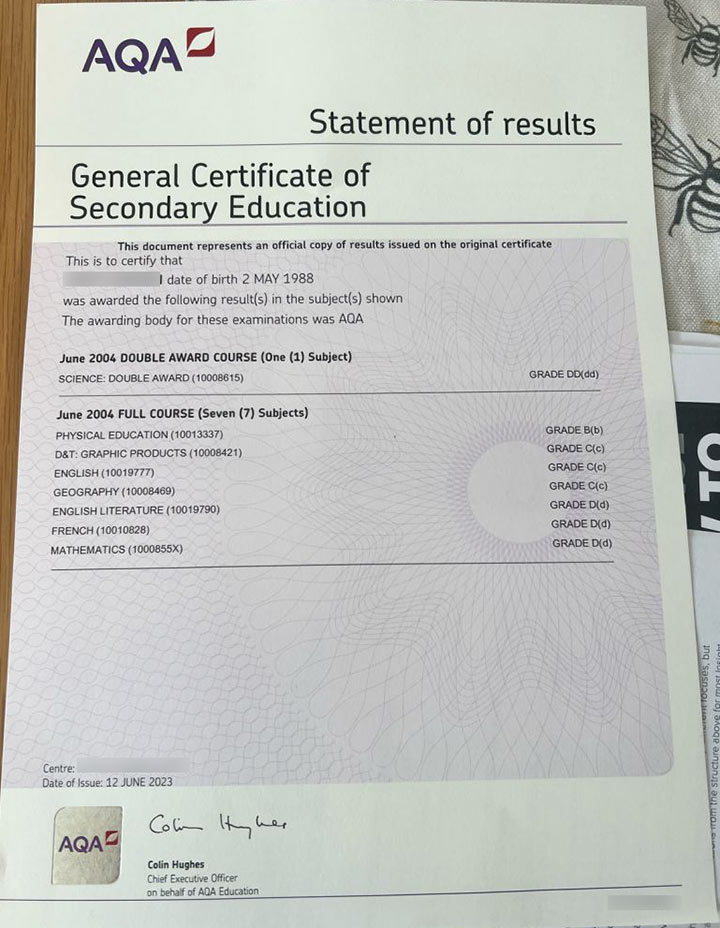
(2023 version of AQA Examinations Authority GCSE Certificate)
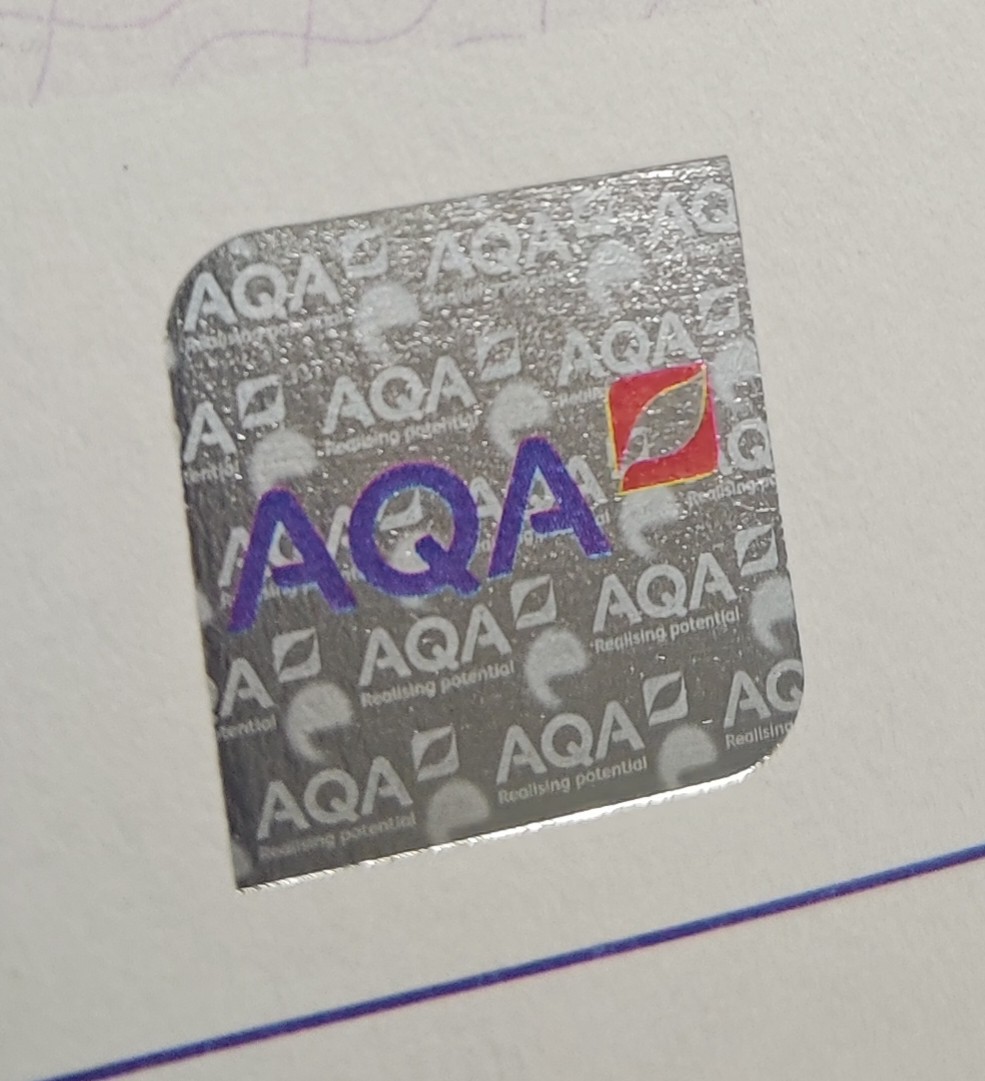
(AQA Examinations Authority GCSE Certificate)
(2023 version of AQA Examinations Authority GCSE Certificate)
(AQA Examinations Authority GCSE Certificate)
What is an AQA certificate?
The AQA L1/ L2 Certificates are the strict equivalent to a GCSE full course, taking 120-140 guided learning hours. Level 1 is attained through grades G(g) to D(d) and Level 2 is attained at grades C(c) to A*(a*).
What qualification is AQA?
Image result for AQA certificate
AQA, formerly the Assessment and Qualifications Alliance, is an awarding body in England, Wales and Northern Ireland. It compiles specifications and holds examinations in various subjects at GCSE, AS and A Level and offers vocational qualifications. AQA is a registered charity and independent of the government.
What is an AQA Level 2 certificate equivalent to?
Level 2: A pass at Level 2 is broadly equivalent to attainment of a GCSE short course at higher tier.
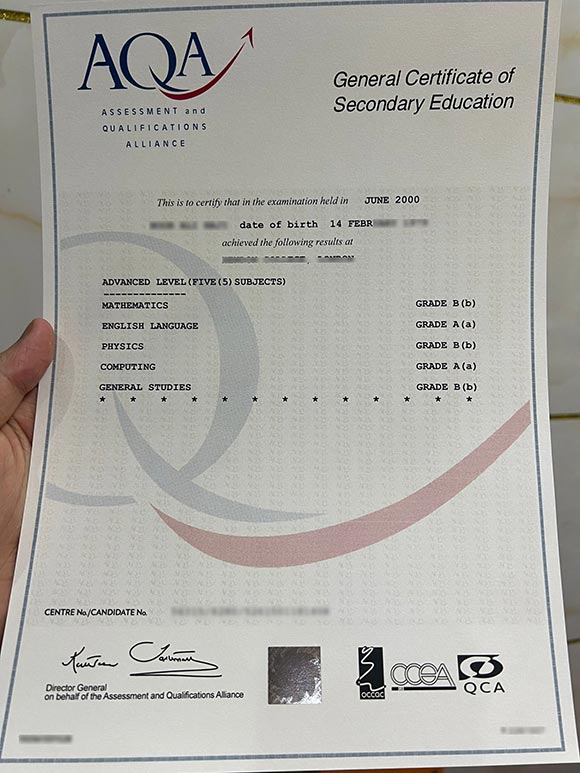
(Sample of AQA GCSE Certificate from 2000)
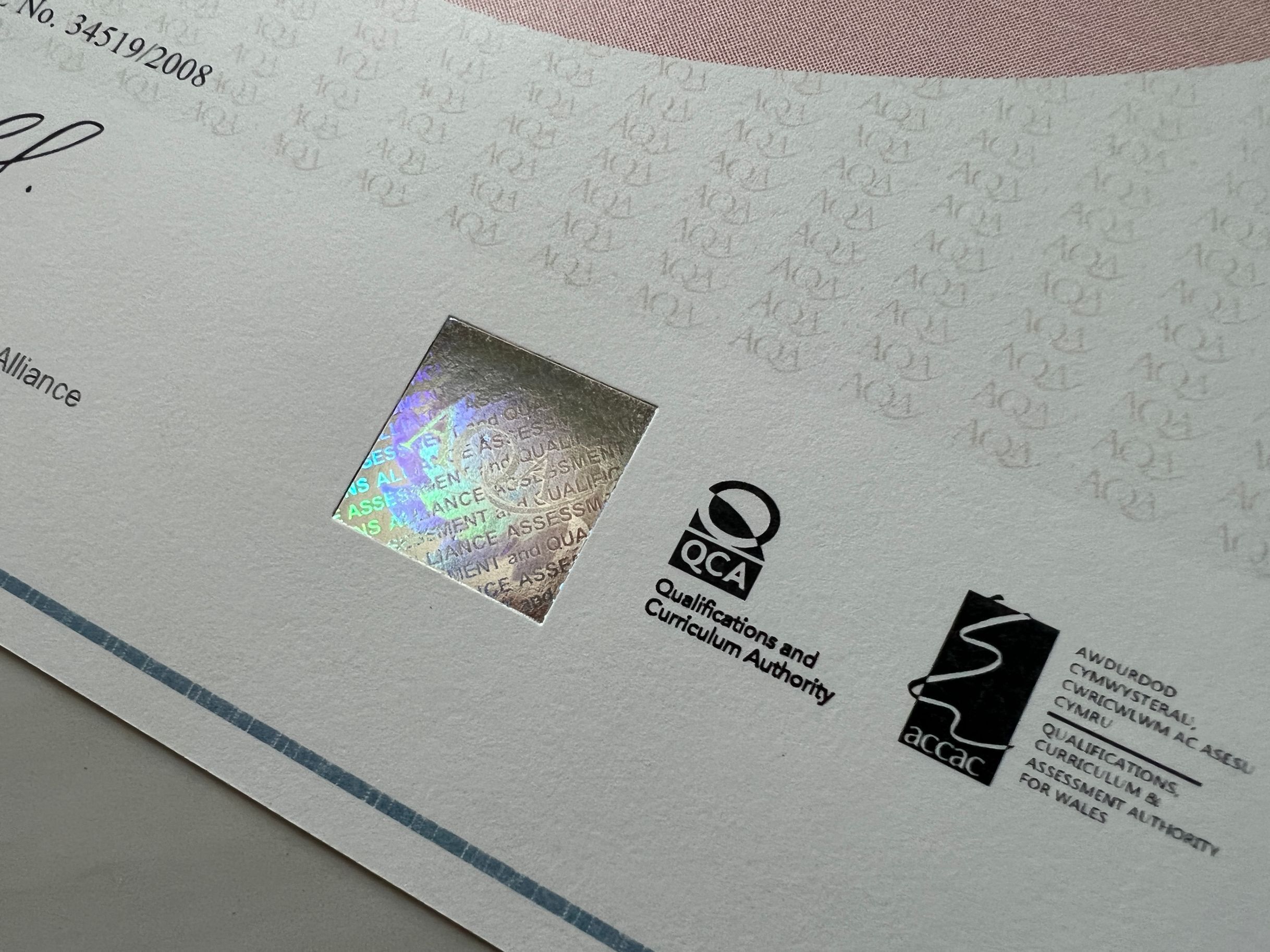
(Sample of AQA GCSE Certificate )
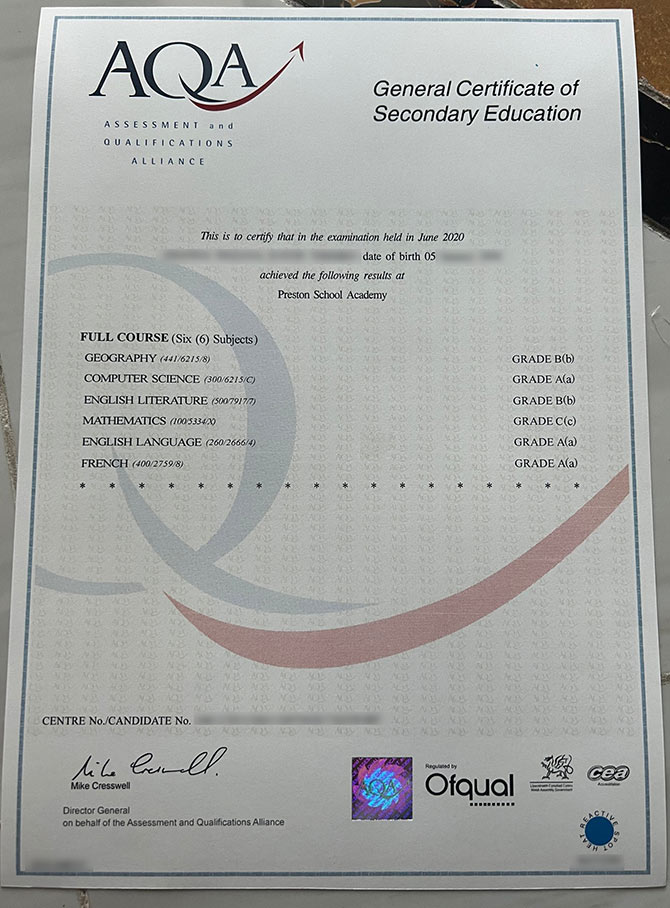
(2020 AQA Examinations Authority GCSE Certificates)
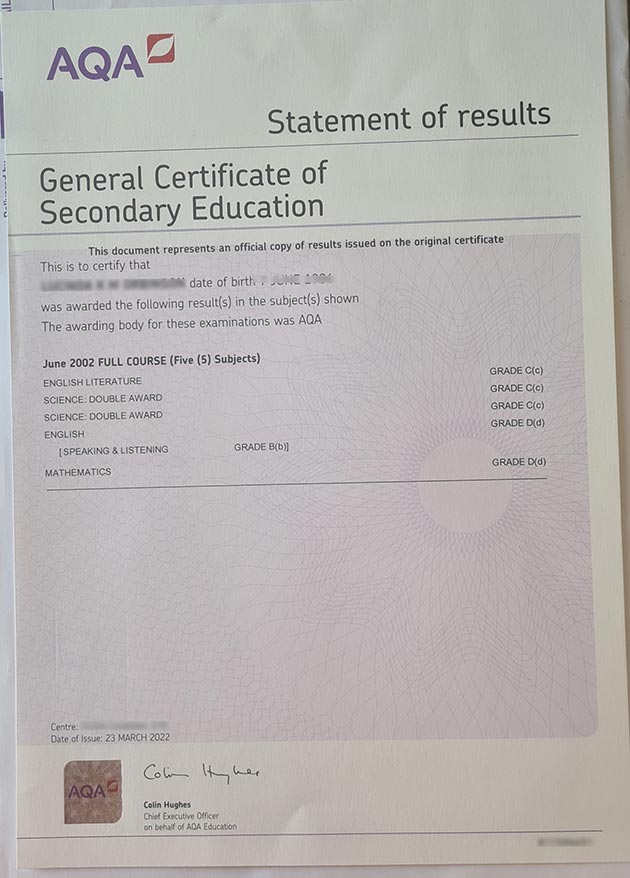
(Samples of AQA GCSE Certificate from 2022)
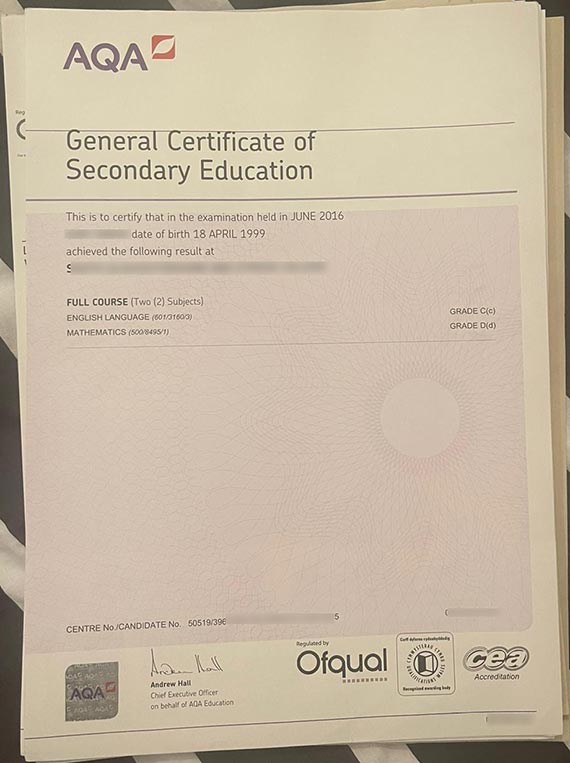
(Sample of AQA GCSE Certificate from 2016)
Is the AQA GCSE exam difficult?
Overall, the pass rate of AQA is the lowest (the average pass rate for English, Mathematics and Science is 77%), while OCR has the highest average pass rate of 83.5%.
(Sample of AQA GCSE Certificate from 2000)
(Sample of AQA GCSE Certificate )
What are the five most difficult GCSE subjects?
Based on student consensus, the difficulty of the exams, and the relatively low proportion of high scores, the five most challenging GCSE subjects are: Advanced Mathematics, Physics, Chemistry, English Literature, and Modern Foreign Languages (French, Spanish, German).
What is AQA GCSE?
AQA GCSE is a General Certificate of Secondary Education (GCSE) exam that is set and marked by the largest academic examination board in the UK, AQA (Assessment and Qualifications Alliance). Students usually take these subject-specific exams upon graduating from secondary school (around the age of 16).
Are AQA and GCSE the same?
AQA is one of the major GCSE examination bodies in the UK. Many schools choose AQA because of its clear examination structure and its close alignment with the national curriculum. AQA offers GCSE qualifications in core subjects such as mathematics, English and science, as well as a range of elective subjects. April 8, 2026
(2020 AQA Examinations Authority GCSE Certificates)
Is the AQA GCSE exam difficult?
Overall, the pass rate of AQA is the lowest (the average pass rate for English, Mathematics and Science is 77%), while OCR has the highest average pass rate of 83.5%.
What are the five most difficult GCSE subjects?
Based on student consensus, the difficulty of the exams, and the relatively low proportion of high scores, the five most challenging GCSE subjects are: Advanced Mathematics, Physics, Chemistry, English Literature, and Modern Foreign Languages (French, Spanish, German).
What will happen if you fail the GCSE exams?
Usually, you can retake any subject you wish to retake. If you are in the 16-19 learning program and your GCSE English, GCSE Mathematics, or one or both of these subjects do not reach grade 4 or above, you will need to continue studying these two subjects. You are not obliged to retake them, but if you and your school both think you are ready, you can choose to retake them.
(Samples of AQA GCSE Certificate from 2022)
Which subject had the lowest pass rate in the GCSE examinations?
According to national examination statistics, in general, the pass rate for the combined science (double award) subject is the lowest. Approximately 42% of students fail to meet the passing standard (level 4 or above). Following closely are mathematics and English language, both of which have a high failure rate and account for the largest proportion of mandatory retake subjects for students over 16 years old.
Are GCSE results recognized internationally?
Yes, GCSE is widely recognized and respected internationally, especially in countries influenced by the British education system or in countries that have international schools offering British curricula.
Do GCSEs count as certifications?
Yes, a GCSE is an academic qualification, and the word "Certificate" is literally part of its name: General Certificate of Secondary Education.
(Sample of AQA GCSE Certificate from 2016)
Is GCSE equivalent to diploma?
A diploma is equivalent to a GCSE only if it is a Level 2 qualification.
Do universities consider GCSE?
Yes, UK universities do look at your GCSE grades, but how much they matter depends heavily on the specific university and course you choose.
What academic level is GCSE?
GCSEs are both a Level 1 and a Level 2 qualification: the level depends on the grade achieved. GCSE grades at 1, 2, 3 (or grades D, E, F, G in the old grading system) are Level 1 qualifications. GCSE grades at 4, 5, 6, 7, 8, 9 (or grades A*, A, B, C in the old grading system) are Level 2 qualifications.
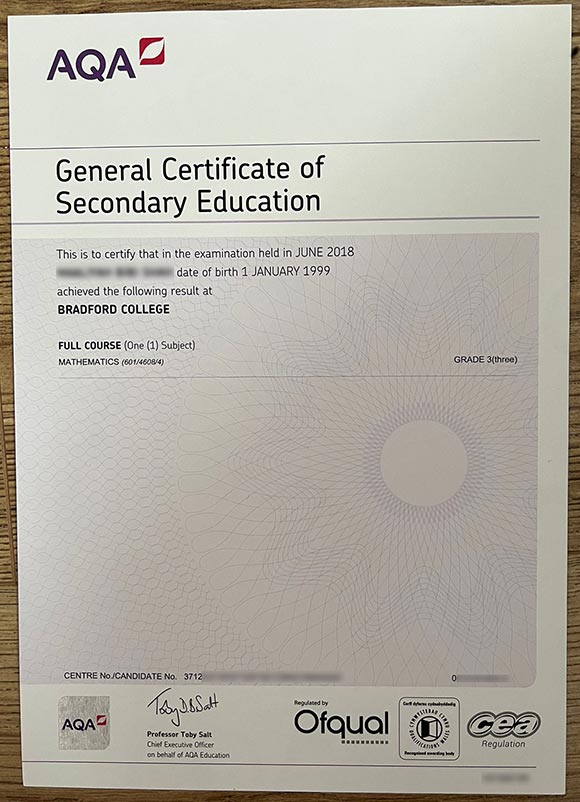
(Sample of AQA GCSE Certificate from 2018)
CATEGORIES
LATEST NEWS
CONTACT US
Wechat: 236461877
WhatsApp: +86 13690285467
Email: diplomacenter@qq.com